

Contents
- How to play Gobak Sodor 3D
- Controls
- Scoring and levels
- Strategy for getting past the guards
- Full screen with a broadcast-style layout
- What is gobak sodor?
- Other names for gobak sodor
- Where does the name gobak sodor come from?
- Traditional gobak sodor rules
- How the 3D version adapts the traditional game
- Frequently asked questions
- Is gobak sodor a traditional game from Indonesia?
- Can Gobak Sodor 3D be played on a phone?
- Does the game need to be downloaded or installed?
- Why does the game not appear or feel slow?
- What is the difference between gobak sodor, galah asin, and hadang?
- How many players are needed for real gobak sodor?
- References
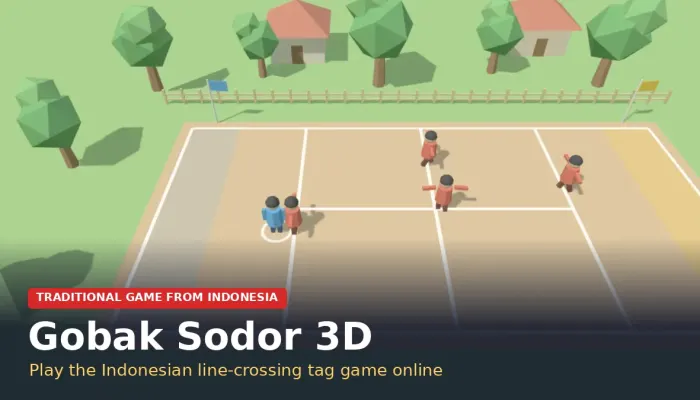
Short answer: gobak sodor is a traditional team game from Indonesia in which attackers must cross a grid of lines, reach the far end of the court, and return home without being tagged by the guards who stand on those lines. Gobak Sodor 3D on this page turns that childhood game into a single-player browser game: one runner, four line guards, three lives, and 60 seconds per round, playable on a laptop or a phone without installing anything.
How to play Gobak Sodor 3D
A round starts after the Start playing button is pressed. The sequence follows the logic of the original playground game: (1) the runner in blue leaves the base on the left side of the court; (2) the runner passes three crosswise lines, each patrolled by one guard in red, plus the long center line, which is patrolled by a fourth guard; (3) the runner touches the yellow zone at the right end; and (4) the runner comes back to the blue zone at the left end. The round is won only when the runner arrives home, so reaching the far side is half of the task, not the whole of it.
Guards move only along their own lines with both arms stretched out. A touch from a guard removes one of three lives and sends the runner back to the base. Consequently, a careless dash costs both a life and valuable seconds. The game ends when all lives are gone or when the 60-second clock reaches zero.
Controls
| Device | How to move the runner |
|---|---|
| Laptop or desktop computer | Arrow keys or the W, A, S, and D keys |
| Phone or tablet | Touch the play area and drag a finger (virtual joystick) |
| Any device | The square button at the top right opens full screen; the note button switches sound on or off |
Scoring and levels
Touching the yellow zone is worth 50 points. Returning to the base is worth 100 points plus 5 points for every second left on the clock. Every round won raises the level, and the guards become faster at each level. Thus, a high score comes from quick and decisive crossings rather than from long waits in front of a line. The best score is stored on the device, and a score can be submitted to the shared leaderboard by typing a name after the game ends.
Strategy for getting past the guards
A guard follows the runner whenever the runner approaches the guard’s line, yet the guard is slower than the runner. Therefore, the feint is the decisive skill: the runner moves to one side until the guard commits, then turns sharply and breaks through on the empty side. The center line requires extra attention, because the center guard moves along the length of the court and can cut a diagonal path from the side. Experienced players also cross each line at the point farthest from the guard instead of the shortest route, since one extra step is cheaper than a lost life.
Full screen with a broadcast-style layout
The full-screen mode borrows the look of a live television broadcast. A red LIVE badge appears in the corner during play, and an advertisement band appears at the bottom of the screen only during breaks, namely on the start screen and on the game-over screen. During active play the band is hidden, so the play area stays clear and no advertisement sits next to the controls. On iPhone, where browsers do not offer a true full-screen mode for page elements, the game expands to fill the whole browser window instead.
What is gobak sodor?
Gobak sodor is a traditional Indonesian children’s game that relies on speed, agility, strategy, and teamwork. Two teams take turns: one team guards the lines of a rectangular court, while the other team attacks by trying to run through every line to the end of the court and back again without being touched. A single tag usually ends the attack and the teams switch roles. The game needs no ball, no bat, and no equipment of any kind, only chalk lines, a patch of open ground, and a group of friends. Consequently, it was for decades one of the most common games in schoolyards and village fields across Java.
The game is widely associated with Yogyakarta and Central Java, and it is also popular among the Betawi people of Jakarta. However, the same game appears under many local names across the Indonesian archipelago, which shows how deeply it is rooted in everyday childhood culture rather than in one single region.
Other names for gobak sodor
| Name | Where the name is used |
|---|---|
| Gobak sodor (also gobag sodor) | Central Java and Yogyakarta; the most widely known name in Indonesia |
| Galah asin or galasin | West Java (Sundanese) and Jakarta |
| Hadang | The name used when the game is played as an official traditional sport |
| Galah panjang | Riau, and also Malaysia |
| Margala | Batak communities in North Sumatra |
| Patintero | The Philippines, where a very similar line game is played |
Similar line-crossing games exist elsewhere in Asia. The Malaysian galah panjang is often compared with atya-patya, an old Indian game, and records note that Dutch children also played the game during the colonial period. Nevertheless, gobak sodor remains recognized as a traditional game of Indonesia, preserved by local schools, cultural offices, and traditional sports communities.
Where does the name gobak sodor come from?
No single origin is confirmed. One popular explanation, cited by the Jakarta cultural office, links the name to the English phrase “go back through the door”, which describes the attackers’ duty to return to the starting line. According to this account, the phrase was difficult to pronounce and gradually became “gobak sodor”. The word sodor is also commonly used for the long center line that splits the court lengthwise, and the guard on that line is often called the sodor guard. Both explanations are folk etymology, so they are best read as part of the game’s oral tradition rather than as settled history.
Traditional gobak sodor rules
Rules vary between villages and schools, because children usually agree on details before each match. Even so, the core structure is stable. The official version played as the traditional sport of hadang standardizes the court and the team size, as summarized below.
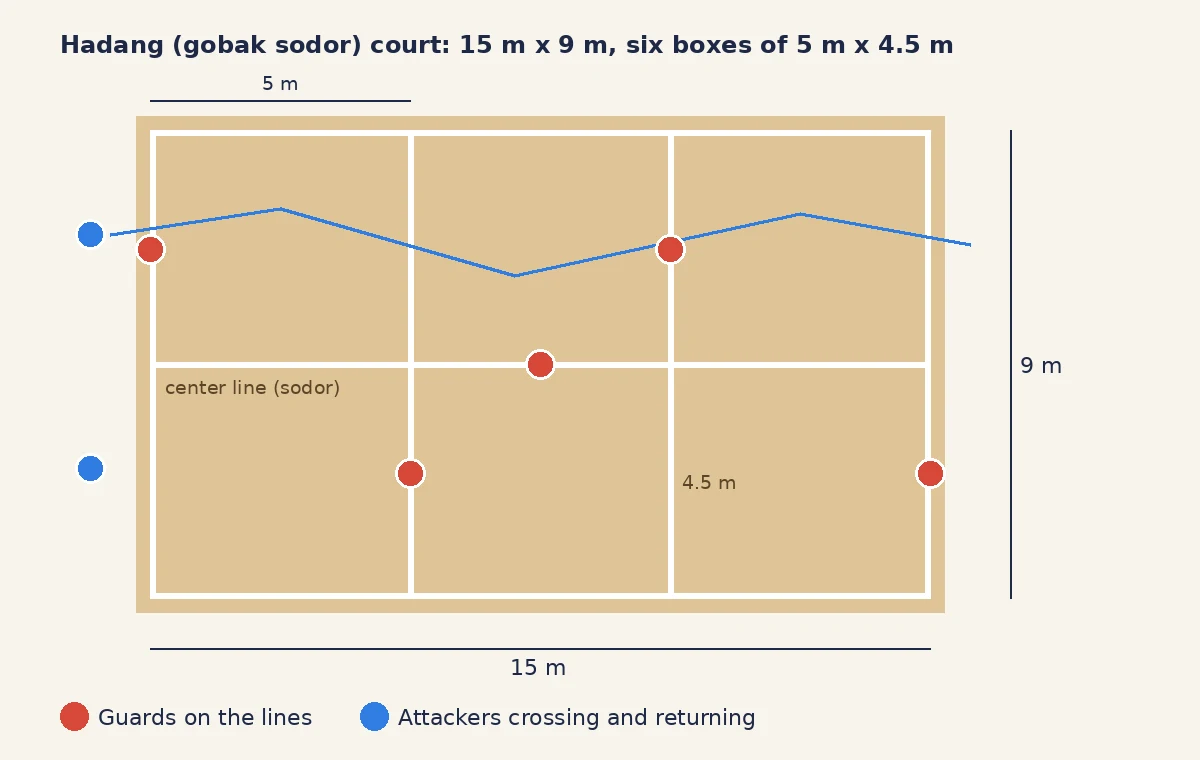
The key elements are as follows. Firstly, the court is a rectangle about 15 meters long and 9 meters wide, divided into six boxes of 4.5 by 5 meters, with a center line that runs the full length of the court. When children play informally, the court is simply scaled to the space available. Secondly, each team in competitive hadang has eight members, namely five active players and three substitutes, while playground games use any even number of players. Thirdly, guards stay on their lines, so they can only block and tag along those lines. Fourthly, in most versions an attacker who is tagged ends the attack for the team, and the roles are reversed. Finally, a team scores when an attacker passes every line, reaches the end of the court, and returns to the starting line untouched.
The design rewards cooperation. Attackers distract guards so that a teammate can slip through, and guards coordinate so that no gap stays open for long. Thus, a simple drawing on the ground becomes a lesson in timing, observation, and team communication, which explains why physical education teachers in Indonesia still use hadang in school programs.
How the 3D version adapts the traditional game
The browser game keeps the heart of gobak sodor and trims the parts that need a full team. The court is drawn as a long field with three crosswise lines and one center line, the guards are bound to their lines exactly as in the playground, and the runner must go out and come back to complete a round. Conversely, the multiplayer elements are replaced by a single runner, a countdown clock, and guards that grow faster with each level, which turns team strategy into a test of individual reflexes and feints.
| Element | Traditional gobak sodor | Gobak Sodor 3D |
|---|---|---|
| Players | Two teams, usually 3 to 5 active players each | One runner against four computer guards |
| Court | About 15 m by 9 m, six boxes, center line | Long field with three crosswise lines and a center line |
| Goal | Cross all lines, reach the end, return untouched | Touch the yellow zone, return to the blue base |
| Penalty for a tag | Attack ends, teams switch roles | One life lost, runner returns to base |
| Time limit | Usually none, agreed by players | 60 seconds per round |
The game runs on standard web technology (WebGL through the three.js library), and the 3D files load only after the start button is pressed, which keeps the page itself light. An Indonesian version of the same game is available on the page Gobag Sodor 3D (Bahasa Indonesia), and both versions share one leaderboard. Another reflex game on this site is Avoid the Ghost 3D.
Frequently asked questions
Is gobak sodor a traditional game from Indonesia?
Yes. Gobak sodor is a traditional Indonesian children’s game, best known in Java and especially Yogyakarta, and it is also played as the traditional sport of hadang. Similar games exist in Malaysia and the Philippines under other names.
Can Gobak Sodor 3D be played on a phone?
Yes. The runner is moved by touching the play area and dragging a finger, which works as a virtual joystick. The full-screen button at the top right makes the play area larger; on iPhone the game fills the browser window.
Does the game need to be downloaded or installed?
No. The game runs directly on this page in modern browsers such as Chrome, Edge, Firefox, and Safari. The 3D files load only after the Start playing button is pressed.
Why does the game not appear or feel slow?
The game requires JavaScript and WebGL support. On older devices, performance usually improves after other browser tabs are closed and the browser is updated to the latest version.
What is the difference between gobak sodor, galah asin, and hadang?
All three names refer to the same line-crossing game. Gobak sodor is the common name in Central Java, galah asin is the Sundanese and Jakarta name, and hadang is the name used when the game is played as a regulated traditional sport.
How many players are needed for real gobak sodor?
Two teams with an equal number of players are needed, usually three to five active players per team on the playground. Competitive hadang uses teams of eight, with five active players and three substitutes.
References
- Dinas Kebudayaan DKI Jakarta. Gobak sodor traditional sports. dinaskebudayaan.jakarta.go.id.
- Museum Sonobudoyo Yogyakarta. Gobak sodor, a traditional Indonesian game full of strategy and teamwork. sonobudoyo.jogjaprov.go.id.
- RRI Voice of Indonesia (2026). Gobak sodor: a childhood game increasingly rare in Jakarta.
- Peraturan permainan olahraga tradisional hadang / gobag sodor (court 15 m by 9 m, six boxes of 4.5 m by 5 m).
- Pudjoatmodjo, B., et al. (2022). Utilizing digital storytelling structure for developing an electronic traditional game gobak sodor. International Journal of Applied Information Technology, 5(1).
- Deda, Y. N., Rosa, M., Disnawati, H., and Tamur, M. (2024). Ethnomathematical perspectives on galah asin: investigating the mathematical and cultural significance of a traditional game.




Discussion
No comments yet. Have a question about this topic? Write it below and I will do my best to answer.